

Ethical or eco-responsible fashion, what are the differences?
Over the past 20 years or so, the fashion industry has become one of the most polluting in the world, due to the need to produce more and more quickly. Fighting global warming has become one of the main concerns today. It is thanks to this awareness that many concepts have appeared: ethical fashion, eco-responsible fashion, slow-fashion, vegan fashion...
But what is the difference between ethical fashion and eco-responsible fashion?
1) Ethical fashion
It aims to improve the social components of trade by defending fair and ethical trade in order to respect human rights. From here, the term sustainable trade emerges, which aims to establish a number of rules on safety, conditions and non-discrimination at work. The fashion sector is sometimes confronted with situations where employees are devalued and have no development prospects. Some organisations apply the standards of the International Labour Organisation or more ambitious ones such as WTFO (World Fair Trade Organisation).
Most ethical brands produce as before, but with certifications that prove that no exploitation has taken place and that workers are paid a fair price. They can also be recognized through labels such as Fair Wear Foundation or Fair Trade, which work to monitor and improve working conditions in the textile industry.
However, this does not mean that these signatures are eco-responsible.
2) Sustainable Fashion?
Eco-responsible fashion, on the other hand, focuses more on the environmental aspect of clothing production. Their production takes into account environmental costs. Eco-responsible brands often use natural fabrics, avoiding synthetic materials that have devastating effects on the environment. Natural materials such as cotton are organic, avoiding the use of pesticides
3) Local manufacturing:
Some brands combine the above concepts of ethical and eco responsible and they try to produce as locally as possible to reduce the environmental impact of transportation.
4) What about Slow Fashion?
A change in consumption via pre-orders or manufacturing ON DEMAND.
If you push the commitment to the end you also try to produce and market differently.
One of the big problems today is OVERCONSUMPTION.
We consume today the annual resources of 1.75 lands. Since the mid 90's the consumption of textiles per year has increased by 40%. Europeans consume 26 kg of textiles per year and throw away 11 kg (the rest is accumulated in overflowing wardrobes).
Most of these discarded textiles (87%) are incinerated or buried in landfills.
These figures are published by the European Parliament.
And only 1% of clothes are recycled worldwide (!).
All these figures make us think, you also?
What is ECOETHICALE?
Indeed, these above concepts must be defended together to achieve common goals:
protecting the environment,
workers
and fighting against overconsumption.
Most brands can therefore define themselves as ethical fashion, but at the same time, eco-responsible, thanks to the shared values. More and more brands are producing their clothing locally for ecological reasons.
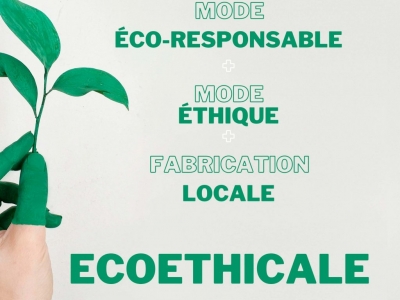
We therefore speak of #ECOETHICAL fashion = ecological + ethical + local.
Vegan fashion
Stemming from veganism, which is opposed to the exploitation and cruelty of animals, vegan fashion includes companies that do not use fur, wool or leather. Indeed, animal husbandry is one of the main causes of global warming and the large quantity of animals for consumption endangers biodiversity. This effectively affirms that vegan fashion is also eco-responsible fashion. The ideal would be to favour local or small-scale production and consumption and to abandon overproduction and the fight to become the world leader.
The design and production of ecoethical clothing
Ecoethicale principles
Ecological and chemical-free materials
For a garment to be ecological, its impact on the environment must be very low. The materials used in the production of these garments are ecological and do not use chemicals. Natural materials: organic cotton, linen, hemp - Natural animal fibres such as mulesing free merino wool or mohair and alpaca made in France. - Artificial fibres: Ecovero and Lyocell
Traceable products
Nowadays, more and more consumers are interested in the origin of the products they consume. Transparency of actions in the production chain is essential, from the origin of the materials to the distribution of the product. The traceability of all the stages of the production of the garment and the workers who contribute to its manufacture allow us to know if we are paying the right price. The transparency of all these steps allows the brand to ensure that its values are respected throughout the process.
Certified factories
In ethical fashion, there are regulations to ensure that garments are made in ethical or fair trade certified factories. The objective of the labels is to certify that, when a brand is relocated to another country, the production of the pieces is carried out in factories that respect the standards of the International Labour Organisation.
Textile labels and certifications
Each year, with the increase in the production of responsible textiles, new labels and certifications appear.
- The GOTS textile certification certifies the organic origin of the textile material as well as environmentally and socially friendly production methods.
- The Oeko-Tex Standard 100 label is based on a sanitary approach by controlling all stages of textile processing to ensure that they do not contain any chemicals or products that are harmful to health.
- The International Fair Trade label certifies the safety of workers, environmental protection, sustainable trade relations, and ensures a fair price for products.
Aatise in all this
At Aatise, we believe in committed and sustainable fashion. We favour short circuits and especially Made In France. Our clothes are made of natural or artificial fibres from nature such as linen or viscose, these materials are biodegradable so as not to leave any trace in the environment.
This is why we have created the ECOETHICALE trend: ecological + ethical + local
Share this content


